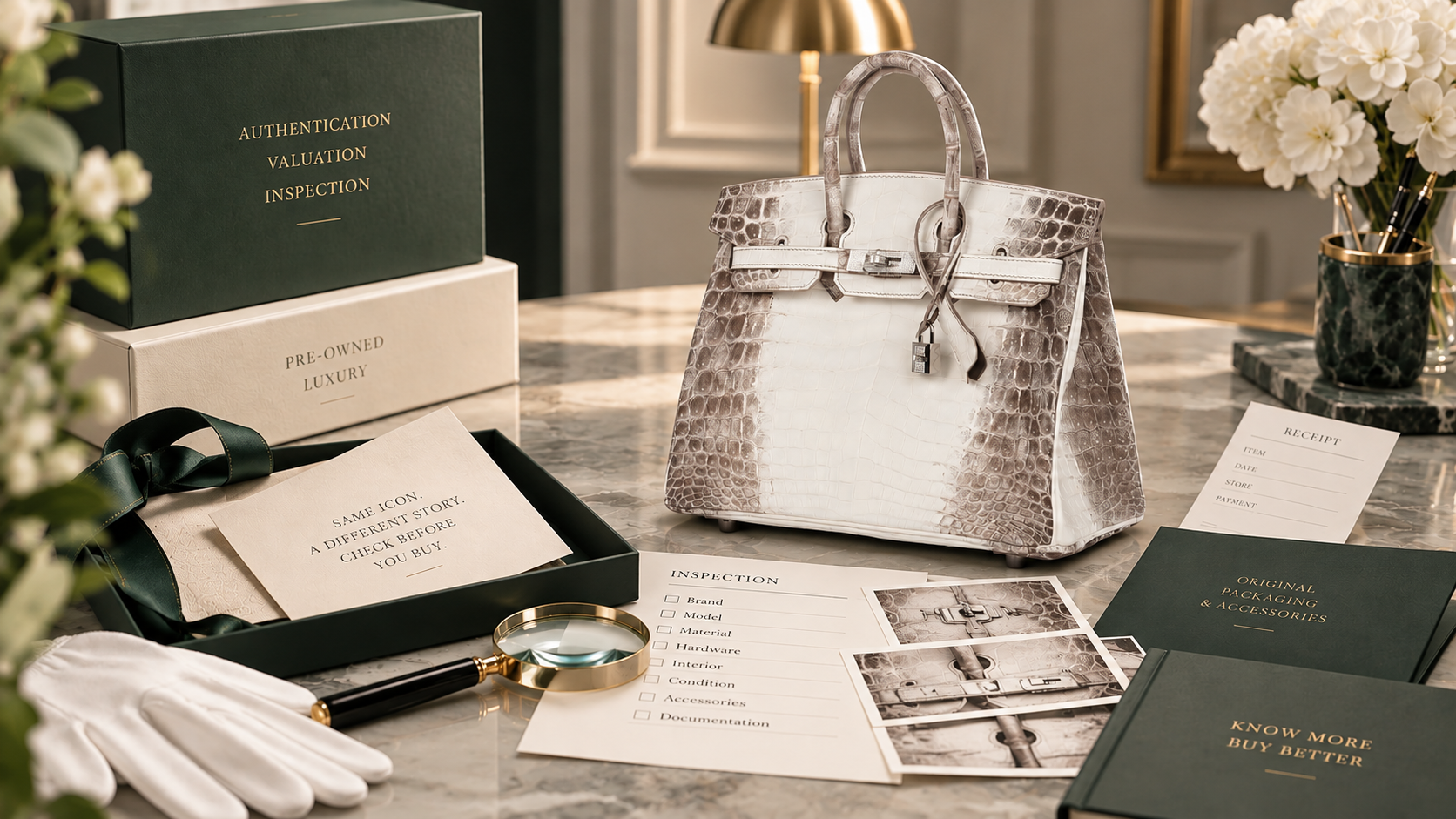
You have photographs, a receipt, a serial number and the original packaging. The asking price is attractive, and you are considering payment.
Before proceeding, there is still a useful question to ask: what do I actually know about this handbag, and what am I assuming?
I treat authentication and valuation as different professional questions. A buying decision adds two more: condition and transaction risk.
Is the item authentic? What is its actual physical condition? Does the asking price make sense for this particular item? What remains uncertain about the evidence, the seller or the transaction?
These questions are related, but their answers are not interchangeable. An authentic handbag may have significant wear or repairs. It may be priced beyond what the relevant market evidence supports. And even when the item itself raises no immediate concern, the terms of the transaction may still leave questions you are not prepared to accept.
Start with the handbag being offered
Establish the brand, model, size, material and stated production period, together with the accessories included in the sale. If part of the description is uncertain, ask what supports it. A comparison is only useful when you understand what you are comparing.
The photographs should show the actual item. Several attractive exterior views may still leave the interior, corners, handles, hardware or a disclosed repair unclear.
More images are not necessarily more evidence. A useful additional photograph answers a specific question.
Condition deserves its own consideration. Ask about wear, deterioration, repairs, replacement parts and alterations, together with any available records. A tidy appearance does not establish that a handbag is unaltered. A repair is something to understand, not an automatic verdict on authenticity.
Consider what those details mean for use, completeness and value. If an important area cannot be assessed from the images, further photographs may help. Where photographs cannot resolve the question, physical examination may still be necessary.
Having information is not the same as having proof
Seller information and provenance can help explain who is offering the handbag and what history is available. The important question is whether those records can actually be connected to the item being offered. A gap in its history is something to understand, not a reason to assume misconduct.
A receipt, packaging or certificate may support the assessment, but none establishes authenticity on its own. A correct serial number cannot settle the question either.
Authentication requires the evidence to be considered together, including the item’s brand, model, material, construction and production period, alongside relevant historical reference information. An observed difference also needs interpretation. By itself, it does not establish that an item is counterfeit.
If an authentication assessment is supplied, read beyond the result. Who issued it? Which item was assessed? What evidence was examined? Was the assessment based on photographs or physical examination? Were any limitations recorded?
Its scope matters. An authenticity conclusion should not be read as a condition assessment or valuation unless those questions were also addressed.
If authenticity remains unresolved, further professional assessment may be appropriate. The useful question is not simply whether more evidence can be obtained, but which uncertainty that evidence is intended to resolve.
When an Authentication Assessment Cannot Reach a Firm Conclusion explains why an unresolved result is neither confirmation of authenticity nor a counterfeit verdict.
Price needs context, not reassurance
A high price does not prove authenticity, and a low price does not prove an item counterfeit. Price matters to the buying decision, but price itself is not authentication evidence.
To consider whether the asking price makes sense, the comparison has to be relevant. Material, condition, repair history and completeness can distinguish one handbag from another of the same model.
Advertised prices also need to be understood for what they are: asking prices. They do not necessarily show what a buyer ultimately paid.
A professional valuation has its own purpose, context and effective date.
As I explain in Authentication vs Valuation: What Is the Difference?, authenticity does not determine value.
My areas of expertise distinguish authentication, valuation and inspection so that the question can be matched to the assessment actually needed.
What remains unanswered before I pay?
By this point, the most useful question may no longer be, “Do I have enough information?”
It may be:
“Is there anything I still do not know that could change my decision?”
That includes the transaction itself. Clarify who is supplying the handbag, what the written description states, how payment and delivery will work, and what the agreed terms provide if the item differs materially from its description or an assessment remains unresolved.
You do not need a complete history of every detail to make a considered purchase. But you should know the difference between something that has been established, something that is merely suggested by the available information, and something that remains unknown.
Resolve the questions that matter before payment, or be clear about the uncertainty you are choosing to accept.