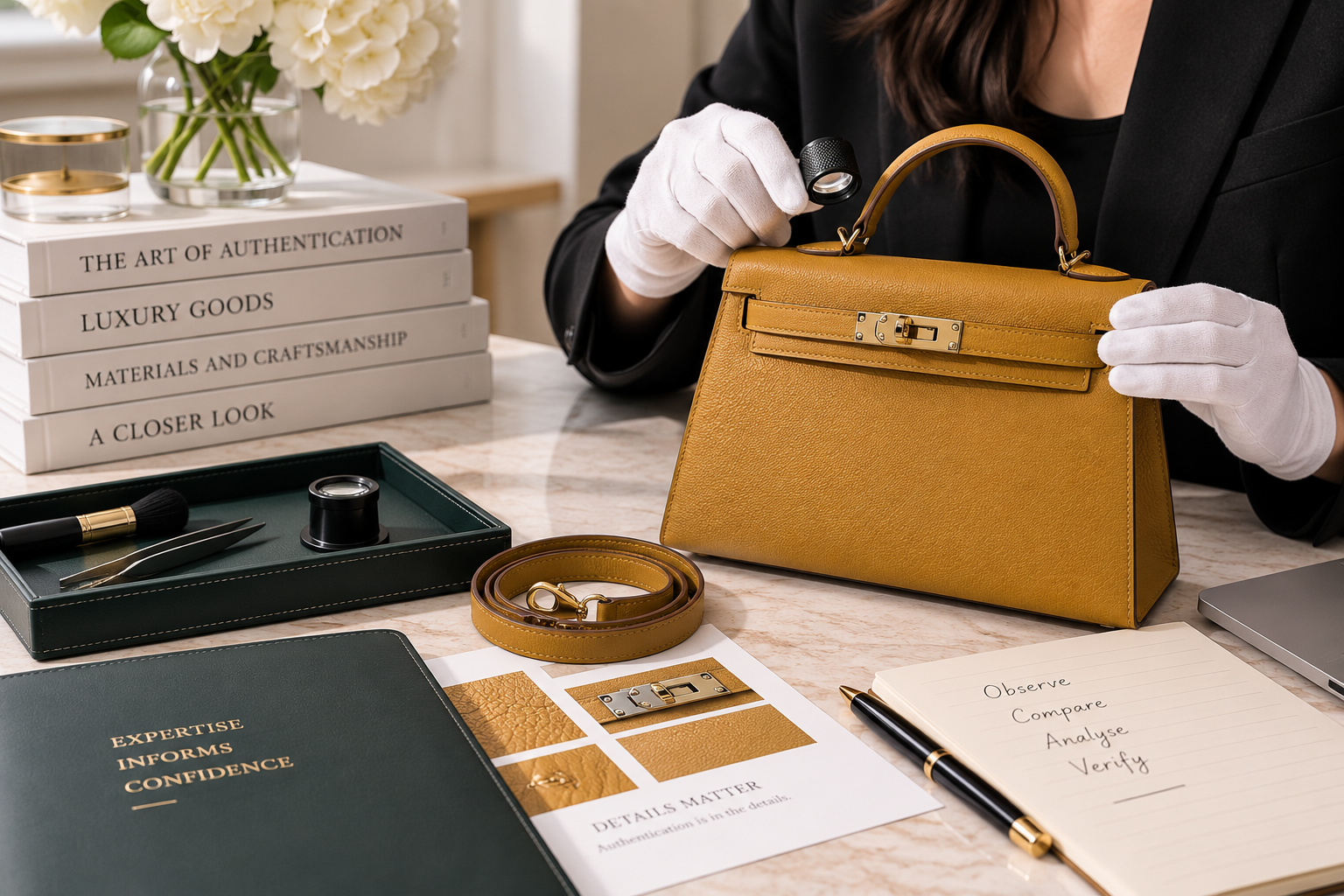
A photograph can show a stitch clearly. It can capture the shape of hardware, the position of a marking or the construction of a particular area.
What it cannot do is place the object in your hands.
That difference matters.
Photographic assessment has an important role in luxury authentication. Good images allow details to be documented, enlarged, compared and reviewed. They can answer many questions efficiently, particularly when the area that matters is visible and the appropriate reference information is available.
But an image is still a representation of an object. It records what the camera captured, under particular lighting, from a particular angle, at a particular moment.
There are times when that is enough.
There are also times when it is not.
What is missing when the object is not physically present?
The first limitation is straightforward: you can only examine what has been captured.
An area outside the frame does not become evidence simply because the rest of the handbag has been photographed thoroughly. Neither does an unclear detail become reliable because other photographs are sharp.
But physical examination is not valuable only because it provides another viewing angle.
Some characteristics are easier to understand through the relationship between different parts of an object. Construction, alignment, movement, finishing and the way components interact may become more apparent when the item can be examined directly.
Material characteristics can also be difficult to interpret from images alone. Lighting, camera processing, compression and screen settings may affect the appearance of colour, texture and surface finish.
A photograph may record an observation accurately while still leaving its significance uncertain.
The question is therefore not whether photographs are good or bad evidence. It is whether the evidence available is capable of answering the question being asked.
Physical examination should have a purpose
I do not regard physical examination as a ritual that automatically makes an assessment more professional.
Having an item on the table does not remove the need for relevant reference information, careful observation or professional reasoning.
The value of physical examination lies in what it allows us to investigate.
If photographs leave a construction detail unresolved, direct examination may provide another way to understand it. If the relationship between components matters, the item can be examined from different positions rather than relying on a fixed set of images. If a surface characteristic appears unusual, it can be considered under different lighting and viewing conditions.
This is also why “send more photographs” is not always the right next step.
The better question is:
What are we unable to establish from the evidence already available?
Once that question is clear, it becomes easier to decide whether a targeted photograph could resolve it, whether physical examination is necessary, or whether the limitation may remain even after further examination.
Direct access does not guarantee a conclusion
Physical examination can provide access to evidence that photographs cannot adequately capture. It does not guarantee that every item will produce a definitive authentication conclusion.
The appropriate historical reference information may still be unavailable. A relevant feature may have been altered, repaired or deteriorated. The evidence may still contain a question that cannot be resolved responsibly.
That is not a failure of physical examination.
It is a reminder that the strength of a conclusion should follow the strength of the evidence, as discussed in When an Authentication Assessment Cannot Reach a Firm Conclusion.
The same principle applies here. Physical examination can expand what we are able to observe. It should not be used to create certainty where the evidence still does not justify it.
The method should follow the question
Technology continues to improve what can be done with images. High-resolution photography, digital comparison and AI-assisted tools can make certain observations faster and more systematic.
I see value in that development. In Can AI Authenticate Luxury Goods?, I explore how technology can support professional judgement.
Technology can help organise evidence, retrieve references and direct attention towards details that deserve closer examination.
But the method should follow the question, rather than forcing every question into the same method.
Sometimes a well-chosen photograph is sufficient.
Sometimes the next useful piece of evidence is another image.
And sometimes the object needs to be physically examined.
Professional judgement includes knowing the difference.